
Stop Teaching Movement Like It’s 2020
Mar 04, 2026Movement changes how people feel and how they think. When you layer a cognitive task onto a familiar movement pattern, participants have to move their bodies, attention, and timing simultaneously. That is where dual-task training earns its place in group-based workouts.
Dual-task training is simply doing a physical task and a cognitive task simultaneously. It sounds simple, but it changes the workout because participants are practising movement control while their attention is elsewhere.
What dual task training looks like in a group fitness or aqua class
You do not need complex choreography. You need a predictable base pattern, clear cueing, and a cognitive task that can be scaled.
Keep the movement pattern simple, then layer a cognitive task on top.
Good base patterns for group fitness
• March, step touch, knee lifts, heel digs
• Squat patterns, small range lunges, hinge patterns
• Balance patterns with taps, like toe taps or heel taps
• Aqua – Cross country ski, jog, jacks, kicks to the front
This is important
In daily life, people rarely move with full focus. They carry shopping, listen to instructions, scan traffic, answer questions, and navigate spaces. Dual-task training lets you safely rehearse that overlap.
Research and guidelines support training balance, strength, and coordination for older adults, especially for falls prevention, and dual-task training is one method that can build capacity in that space. World Health Organisation guidance includes balance, strength, and multicomponent activity for older adults. https://www.who.int/publications/i/item/9789240015128
Exercise and Sports Science Australia also outlines exercise approaches for falls prevention, with balance and strength as key elements. https://www.essa.org.au/Common/Uploaded%20files/Publications/Position-statement-updated-exercise-falls-prevention.pdf
If you want peer reviewed summaries specific to dual task training and balance, PubMed is the easiest place to pull systematic reviews for your references list. https://pubmed.ncbi.nlm.nih.gov/?term=dual+task+training+balance+older+adults+systematic+review
How to teach this effectively
This is where instructors make the difference. The goal is not to “test” people, it is to teach attention under load.
Teach it like this
• Teach the movement first, then add the cognitive task
• Keep the cognitive task short, then reset
• Cue less than you think, then give processing space
• Give permission to drop the thinking task and keep moving
• Use timing structures that the class already knows, like switching tasks every 8 or 16 counts
• Offer levels from the start, so nobody feels behind
Ready to use ideas, with clear examples
These are written so you can plug them into a warm up, cardio block, strength set, or balance focus.
1) March (or jog in the pool) on the spot plus counting backwards
Movement, march on the spot with relaxed arms
Cognitive task, count back from 60 in 3s
Coaching tip, if someone loses the count, they rejoin on the next number they hear, no stopping
2) Step touch (or cross country ski in the pool) plus category naming, with a clear example
Movement, step touch side to side
Cognitive task, name sports, tennis, cricket, netball, swimming, then on your cue switch to fruits, apple, pear, mango, banana
Progression, after the switch, nobody can repeat an item that has already been said
Regression, they can name any item, repeats allowed
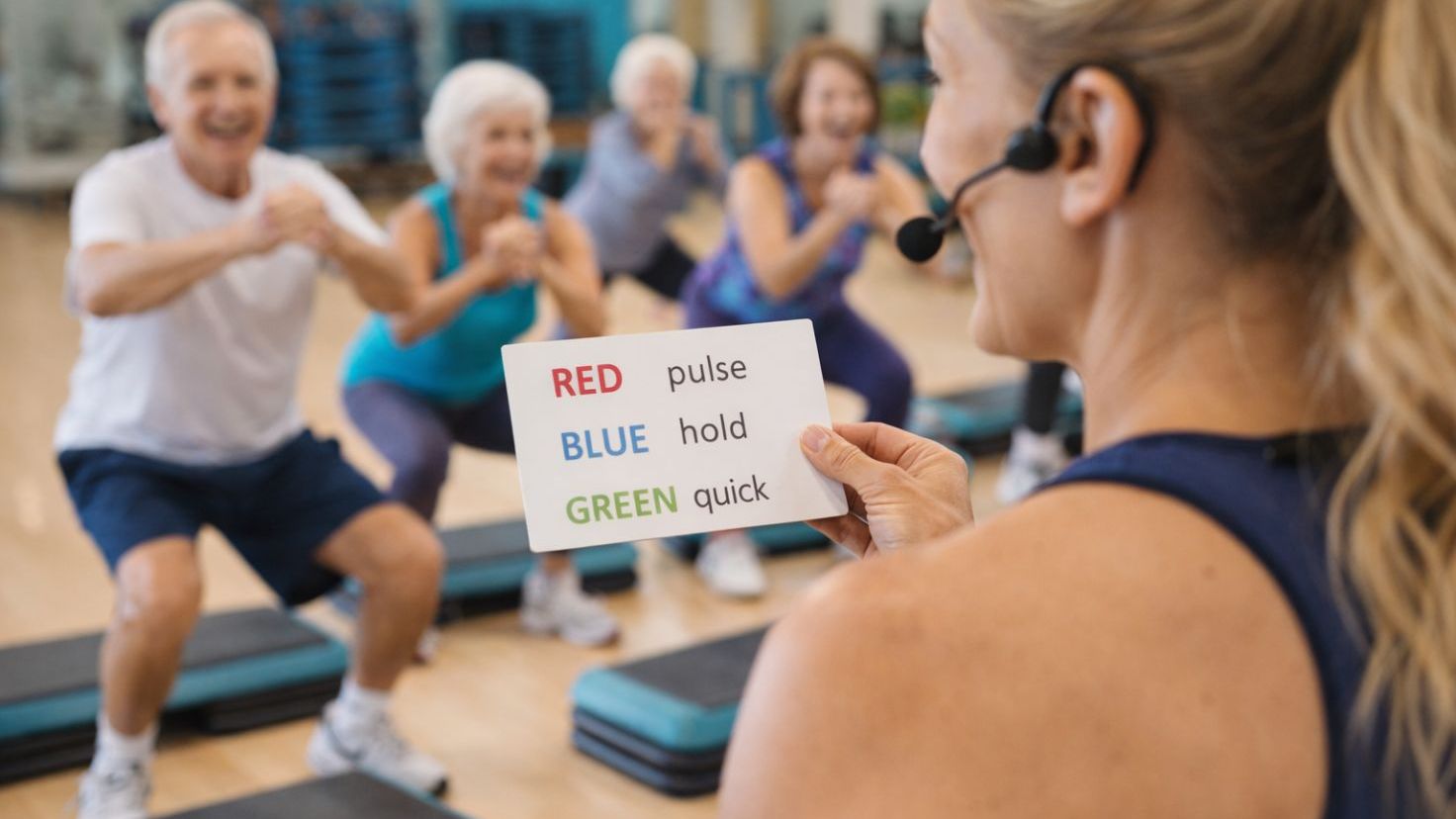
3) Squat plus a decision rule
Movement, squat and reach
Cognitive task, if you call “red” they add one pulse at the bottom, if you call “blue” they hold the squat for a two count
Structure, change the call every 8 counts
Regression, remove the pulse and keep the hold only
Progression, add a third colour that changes tempo, like “green” equals four quick squats
4) Single leg balance plus spelling
Movement, single leg stance with toe taps forward, side, back, then swap legs
Cognitive task, spell a short word out loud with each tap, S T E P, then swap word to B A L A N C E
Regression, taps only, no spelling
Progression, spell the word backwards, or change the word on your cue
5) Seated knee lifts plus timing patterns
Movement, seated alternating knee lifts
Cognitive task, “two slow, four quick”, then switch to “four slow, two quick”
Why it works, they are listening, processing, and matching timing, which suits a group fitness format
Progression, add an arm pattern only on the slow reps
6) Travelling pattern plus memory chain, swap in for grapevine if you want
Movement, two side steps right, two side steps left, or a simple walk pattern around a marker
Cognitive task, build a list one item at a time, “hat”, then “hat, shoes”, then “hat, shoes, keys”
Regression, keep the list at two items
Progression, recall the list in reverse order on your cue
Learn More at the 2026 MGM Group Fitness Conference
If this topic sparks your interest, you’ll love what’s coming next.
At the 2026 MGM Group Fitness Conference on May 3, presenter Cammy Dennis will dive deeper into Dual Task Brain Training in a Group Setting. This session will showcase practical drills, programming frameworks, and ready to use ideas you can immediately bring into your classes.
You’ll walk away with
• New dual task combinations
• Progression strategies for mixed ability groups
• Creative cognitive layering ideas
• Tools to design your own brain boosting drills
Whether you teach active agers, aqua, or general group fitness, this session will expand your coaching toolbox in powerful ways.
Mark your calendar for May 3, 2026, and get ready to train bodies and brains together.
Click Here To Sign Up for MGM Group Fitness Virtual Conference
Sign up for free education!
Unlock the power of music in group fitness and enhance your teaching skills - sign up now for two free webinars and elevate your fitness instruction!
We hate SPAM. We will never sell your information, for any reason.
