
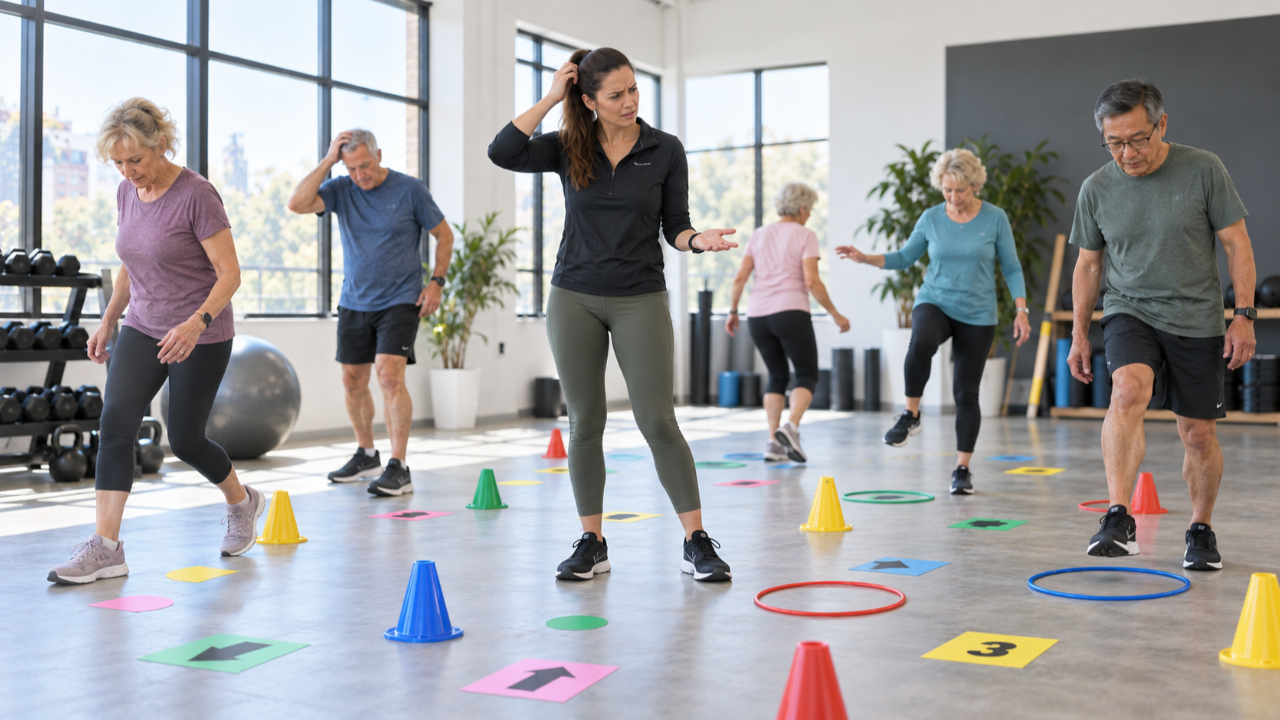
Your Brain Drills Might Be a Waste of Time
Sep 23, 2026This year, two studies looked at brain training from very different angles. One followed people for 20 years. The other tested dual tasking in the pool. Both point to the same thing, and it is something most instructors are getting wrong.
The Brain Training That Still Worked After 20 Years
In February 2026, researchers from Johns Hopkins and partner universities published the 20-year follow-up of the ACTIVE study. Almost 2,800 adults aged 65 and over were split into groups that trained memory, reasoning, or speed of processing. The training was modest: ten sessions over five to six weeks, with some participants given booster sessions at 11 and 35 months.
Twenty years later, the speed training group who had the boosters had 25% fewer dementia diagnoses than the control group. The memory and reasoning groups showed no significant difference.
The researchers pointed to one feature of the speed training. It was adaptive. As a person got faster, the task got harder, so everyone kept working at the edge of their own ability.
It is worth being clear about what this study is. It was seated, computer-based training, and it is one trial. The researchers themselves say more work is needed to understand why it worked. It does not tell us that a group fitness class prevents dementia, and we should never promise that to participants.
They Put Brain Drills in the Pool. Here's What Happened.
On 2 September 2026, a team in Brazil published a trial in Frontiers in Physiology. 67 older women were placed in one of three groups for 14 weeks: water exercise with dual-task demands added, conventional water exercise, or no exercise.
Adding the dual tasks did not produce consistent extra gains in global cognition. One measure did move. Semantic verbal fluency, which is naming as many words as you can in a category, improved in the dual-task group and dropped in the conventional water exercise group.
That is not a reason to drop cognitive tasks from your aqua class. It is a reason to think harder about how you design them.
Why the Same Drill Challenges One Person and Bores the Next
A cognitive task on its own does not do much. What the research keeps pointing to is how the task is designed.
Adaptive. The task needs to meet each person where they are. When I use an alphabet category task in class, such as naming a food for every letter, some participants reach O or P while others are still on D or E. Same task, very different challenge. A fixed task is too easy for one person and overwhelming for the next.
Progressive. The ACTIVE boosters are a reminder that coming back to a skill matters. A new brain game every week keeps a class interesting, but it does not build anything. A task that returns and gets harder does.
Specific. People get better at what they practise. The aqua trial improved verbal fluency because participants were practising exactly that kind of thinking. Choose your task for the skill you want to train, whether that is reaction time, working memory, switching, or decision-making.
Fast. The training that lasted in ACTIVE was about processing speed: seeing, deciding, and responding quickly. That is closer to reacting to a cue in class than to memorising a list.
Why Your Class Slows Down When They Start Thinking
There is one more design problem, and it is the one instructors see first. When you add a cognitive task, physical output drops. This is called the dual-task cost. Participants slow down, shorten their range, and lose intensity, usually without noticing.
Add the task too early, or onto a movement the class does not know yet, and you lose on both sides. The workout drops, the thinking becomes overwhelming, and the class stops being enjoyable. I made exactly this mistake the first time I tried it. I added a cognitive task onto a movement my participants were still learning, so they were learning a movement, coordinating it, and thinking all at once.
That is the thinking behind my session at Aqua Immersion, Train, then Brain. The physical training comes first and the cognitive challenge is layered in after, so participants get the workout they came for and the brain challenge on top, rather than a watered-down version of both.
Go Deeper with Cammy Dennis
If adaptive, progressive design is the part that matters, it is also the part most instructors have never been taught. That is exactly what Cammy Dennis covers in Cognitive Motor Training: Create Brain Health Classes With Purpose and Progression.
Cammy will unpack the neuroscience behind attention, reaction time, decision-making, and dual tasking, then show you how to build safe, progressive drills that work in a group setting. You will leave with a framework for building cognitive motor drills into your classes and practical strategies you can use across different formats.
Sunday 8 November 2026, 8am to 11am AEDT
Lifetime access to the recording
5 AusActive CPDs and 2 REPs NZ CPDs
Early bird $119 until midnight 7 October, then $139.
Click Here To Register
Teach Aqua? Catch Train, then Brain
If you missed Aqua Immersion in September, the recordings are still available, including Train, then Brain alongside sessions from Melissa Plumeau, Vanessa Leone, Dave Liow, and Maria Teresa Stone. Lifetime access for $209, with 6 AusActive CPDs, 8.5 REPs NZ CPDs, and 30 FitRec points.
Get The Aqua Immersion Recordings
Sources: Coe et al., "Impact of cognitive training on claims-based diagnosed dementia over 20 years: evidence from the ACTIVE study", Alzheimer's & Dementia: Translational Research & Clinical Interventions, 2026 (link). Miranda et al., "Added Effects of Dual-Task Water-Based Exercise on Global Cognition and Physical Performance in Older Women: A Three-Arm Randomized Controlled Trial", Frontiers in Physiology, 2026 (link).
Sign up for free education!
Unlock the power of music in group fitness and enhance your teaching skills - sign up now for two free webinars and elevate your fitness instruction!
We hate SPAM. We will never sell your information, for any reason.
