
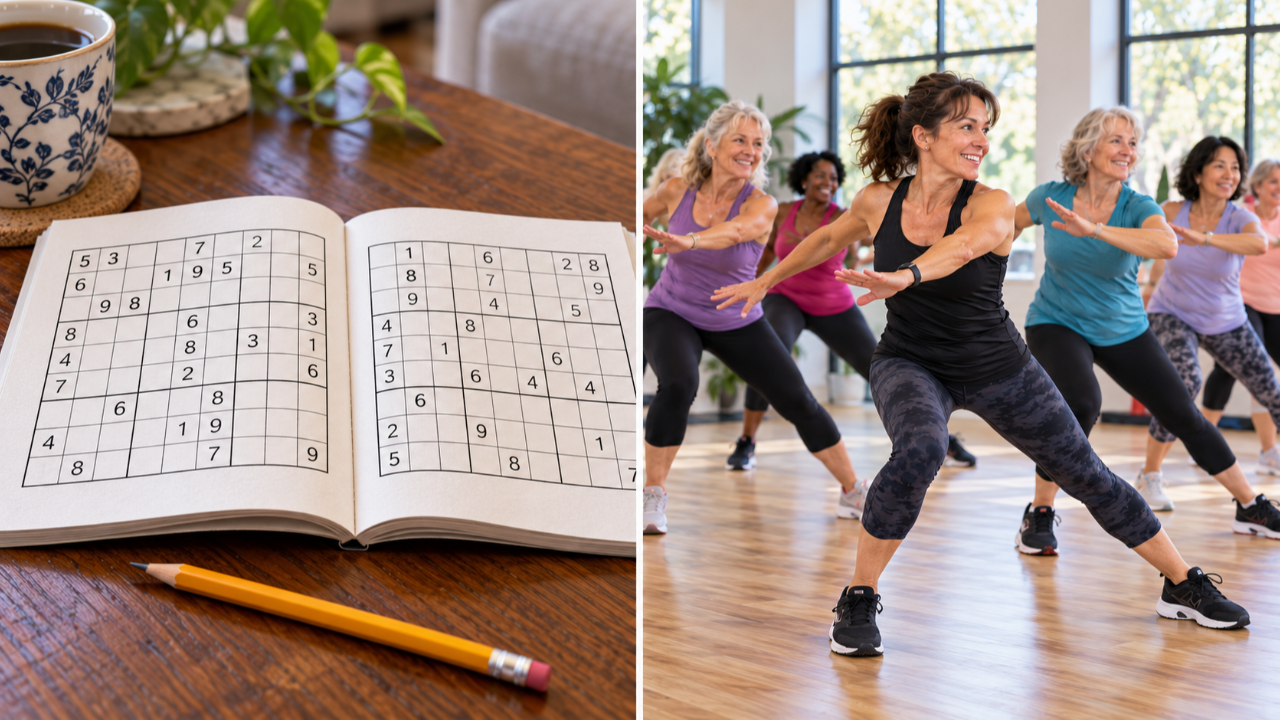
Stop Doing Sudoku. Start Doing This.
Oct 07, 2026Millions of people do a puzzle a day because they believe it keeps their brain sharp. The research points somewhere far more interesting, and it is a place your participants already visit every week: your group fitness class.
Sudoku Makes You Good at Sudoku
Sudoku, crosswords, word games, and brain-training apps all rest on the same promise. Practise this, and your whole brain gets better.
In 2016, a team of psychologists put that promise to the test. They reviewed the 132 studies that brain-training companies and their supporters cited as proof. What they found was simple. People got better at the tasks they practised. There was little evidence that the improvement carried over into everyday thinking or real-world tasks.
The same principle applies to the puzzle book on the coffee table. Do a Sudoku every day and you become very good at Sudoku. Whether that helps you remember where you parked the car is another question entirely.
Puzzles are enjoyable, and enjoyment counts for a lot. They are just a narrow form of training.
Thinking While Moving Wins
So what works better? Combining the two.
A 2018 meta-analysis of 41 studies in older adults found that programmes mixing physical activity with cognitive challenge improved thinking more than physical activity alone. The gains were greatest when the physical and cognitive work happened together, rather than one after the other.
A larger network analysis compared different ways of combining training. Doing both at the same time came out on top for cognition, ahead of doing them in sequence and ahead of cognitive training on its own. It also improved physical function as much as exercise alone did.
In other words, dual tasking gives you the brain challenge and the workout in one. Sudoku only gives you one of those.
The Rowing Crew That Felt Less Pain
Here is where it gets interesting for group fitness.
In 2010, researchers at Oxford asked university rowers to train on rowing machines, sometimes alone and sometimes as a crew moving in time together. The workload was the same. Afterwards, the researchers measured how much pressure the rowers could tolerate from a blood pressure cuff before it became uncomfortable. This is a common way of estimating endorphin release.
The rowers tolerated more pain after training together in sync than after the same session alone. The researchers suggested that moving in time with other people boosts the endorphin effect beyond what exercise alone produces.
This has been called the synchrony effect, and it has since been studied in drumming and dancing too. Endorphins are linked with mood and with social bonding, which may help explain why moving together feels so good.
One smaller follow-up study found the effect was stronger when rowers trained with teammates than with strangers. Think about what that means for the regulars who stand in the same spot every week and know each other's names.
Your Class Has Something No App Can Copy
Put those two findings side by side.
Thinking while moving does more for the brain than thinking alone. Moving in time with other people adds a mood and bonding effect that a solo workout cannot match.
A group fitness class is one of the few places where both happen at once. The music sets a shared beat. Everyone changes direction on the same count. The room responds to your cue together. Add a cognitive challenge and you have dual tasking, in synchrony, in a community.
That is the real competitive edge of group fitness, and it comes from you. The instructor is the one who creates the shared rhythm. An app cannot do that.
How to Make the Most of It
Get everyone on the same beat. Synchrony starts with timing. Clear phrasing, strong counts, and music with a beat people can feel keep the whole room moving together.
Change together. Direction changes, arm switches, and transitions on the same count are moments of shared timing. Cue them early enough that the whole room arrives together.
Let them see each other. Formations where participants face each other, or turn to face a new wall together, make the group visible. Moving with people you can see builds that sense of being in it together.
Make the brain challenge shared. Count backwards as a room, or have everyone report how far they got in the break. The thinking becomes something the group does together, and the mix-ups become part of the fun.
Laugh at the mistakes. When half the room turns the wrong way, that is the brain working hard. A shared laugh is its own kind of synchrony, and it keeps people coming back.
Go Deeper with Cammy Dennis
If you want to build cognitive drills that work for a whole room, Cammy Dennis covers exactly that in Cognitive Motor Training: Create Brain Health Classes With Purpose and Progression.
Cammy will unpack the neuroscience behind attention, reaction time, decision-making, and dual tasking, then show you how to build safe, progressive drills that work in a group setting. You will leave with a framework for building cognitive motor drills into your classes and practical strategies you can use across different formats.
Sunday 8 November 2026, 8am to 11am AEDT
Lifetime access to the recording
5 AusActive CPDs and 2 REPs NZ CPDs
$139
Click Here To Register
Sources: Simons et al., "Do 'Brain-Training' Programs Work?", Psychological Science in the Public Interest, 2016 (link). Gheysen et al., "Physical activity to improve cognition in older adults: can physical activity programs enriched with cognitive challenges enhance the effects?", International Journal of Behavioral Nutrition and Physical Activity, 2018 (link). Gavelin et al., "Combined physical and cognitive training for older adults with and without cognitive impairment: a systematic review and network meta-analysis" (link). Cohen et al., "Rowers' high: behavioural synchrony is correlated with elevated pain thresholds", Biology Letters, 2010 (link). "The Synchrony Effect: the influence of teammates' and strangers' participation on endorphin levels during physical activity" (link).
Sign up for free education!
Unlock the power of music in group fitness and enhance your teaching skills - sign up now for two free webinars and elevate your fitness instruction!
We hate SPAM. We will never sell your information, for any reason.
